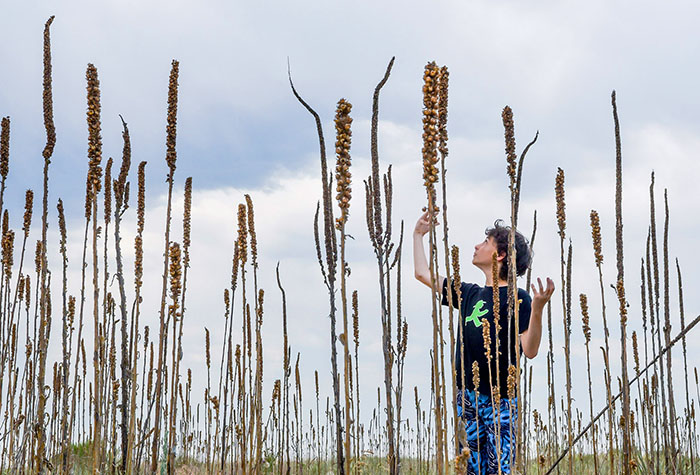
Writers, graphic artists, musicians and photographers are among the first to feel it.
The AI invasion.
For those of us who have spent a lifetime developing our skill, fine-tuning our senses and unleashing our imaginations, the horizon looks bleak.
Music made by machines. Videos and photographs depicting events that never happened. Novels with no human author.
What becomes of the creative spirit when creativity is no longer needed?
For millennia, humans have etched, painted, written, built and composed. We learned to capture light rays on film in a photograph. We discovered how to string together a succession of still images to create the illusion of motion –– giving birth to cinema.
Each new medium expanded the possibilities of human expression. Each demanded its own set of skills. Each enabled new expressions of our senses.
Now imagine a world in which a machine can produce a symphony in seconds, generate a gallery of paintings before breakfast or create a photograph of a moment that never occurred. Imagine a world where the imitation is so convincing, so inexpensive and so readily available that the human effort behind an original work is no longer valued. What incentive remains for the young musician to spend years mastering an instrument, the aspiring artist to struggle with a blank canvas or the photographer to venture into the world in search of a landscape or a moment worth preserving?
Of course, people will continue to create. The impulse won’t simply disappear because a machine can do the work. But what happens when that impulse is no longer encouraged, when the skills that once gave it form are no longer taught, when creative work can no longer sustain the people who dedicate their lives to it? What happens when an entire generation grows up believing that making something is pointless because a machine can make it faster?
Perhaps the greatest danger isn’t that AI will replace human creativity. It’s that we will gradually lose the reasons, the opportunities and ultimately the inclination to exercise it. We risk becoming consumers of endless synthetic content rather than participants in the deeply human act of making something that did not exist before.
And that loss would extend far beyond art. Creativity shapes how we solve problems, interpret experience, challenge convention and imagine a future different from the present.
Art is not a decorative extra in civilization. It is a force of enlightenment.
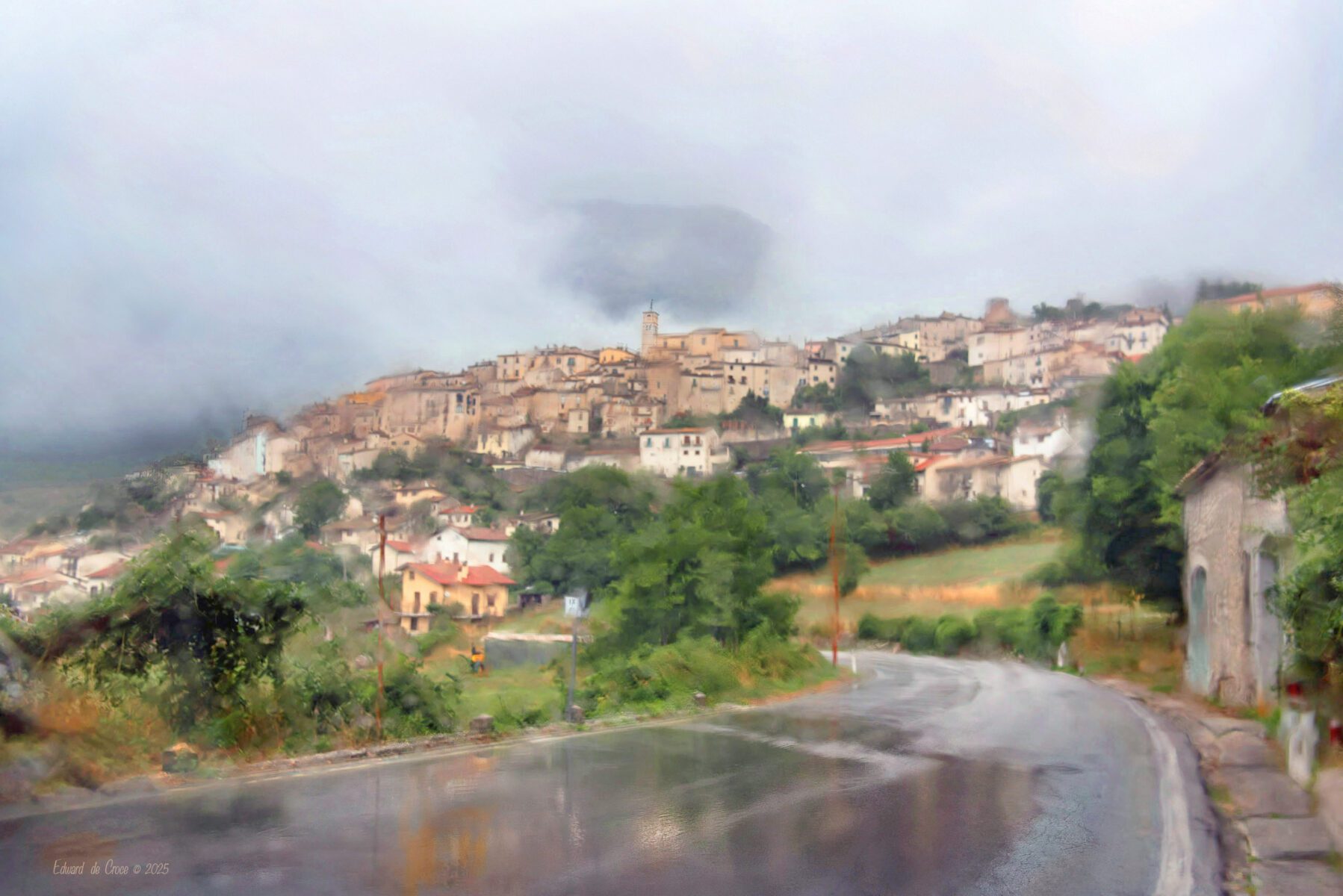
If it looks like a watercolor, that’s because I shot through water. The scene is photographed through the rain-soaked windshield of my tiny rented Fiat.
The birthplace of my grandparents: Villetta Barrea, is in the province of L’Aquila, in the Abruzzo region of central Italy.
Pictures tell stories. And I suppose AI-generated ones do, too. But there’s a deeper story behind this photograph. After a commercial travel company photoshoot in Tuscany, I rented a car and drove to Abuzzo where I met some cousins for the first time.
As much as I love the composition and impressionistic feel, this picture is connected to my heart. It’s a connection to my family’s history –– to a place I never knew through my ancestor’s eyes. It connects me to the generations who came before.
Artificial imaging can make pretty pictures. But it can’t replace the human experience.
Art and AI:
A Hostile Takeover
Writing history about current times while still in the present is journalism based on opinion. But events unfolding right now—in 2026—signal an irreversible paradigm shift unlike anything in human history. Call me an alarmist or a doomsday proponent, but consider these fundamental facts:
Climate Change
From a geological perspective, the rate of warming is lightning-fast. If Earth measures time on the scale of its four-billion-year history, the Industrial Revolution—a mere 200 years ago—is little more than a drop of mosquito piss in the ocean. Yet in that geological blink of an eye, we’ve altered the chemistry of our atmosphere while reshaping the planet’s climate.
Genocide, Expansionism and Greed
Okay, nothing unprecedented here. The fact is, human behavior hasn’t evolved much since Genghis Khan. But the scale of our destructive power has changed dramatically. Mr. Khan didn’t possess the weaponry to threaten humanity’s survival. Today, the powerful and the wealthy exploit their positions to oppress populations and enable the slaughter of millions. Meanwhile, lies, propaganda and catchy shibboleths blind followers to the immorality of those they support.
Artificial Intelligence
With so much to ponder, this article is about a hostile takeover. It’s about art and AI, about the future of human creativity, and about what happens when machines produce art that once required human experience, imagination and skill.
We’re building systems whose capabilities are advancing faster than our ability to understand or control their consequences. As AI takes the reins, humanity confronts a future of its own making.
Are we entering into a macabre new world where human creativity is obsolete and AI agents dictate the terms of our existence?
or
Will AI be our saviour –– our benevolent dictator?
Stories Behind Images

The Experience Behind the Photograph
In early spring, I was shooting an industrial site at dawn. I had already captured the night shots. I already worked through sunrise, photographing the operation in warm light.
But photographers are rarely finished when the assignment says they are. We keep looking until the ideas—or our energy—runs out. So I drove the country roads surrounding the operation, searching for unusual perspectives. Then I spotted them.
Thousands of geese covering a dormant cornfield.
I pulled over and grabbed my 400mm. Another camera with a wider lens hung from my shoulder. So I started shooting from the roadside, then crept closer… And closer… Eventually, I crossed the fence.
I did wonder if the farmer might take a shot in my direction. But I kept moving slowly into the field, photographing as I went. With every step, one thought kept running through my head:
Wouldn’t it be great if a few of those birds took flight?
Then they did.
Not a few.
The entire flock exploded. Thousands of birds rose from summer’s corn stalks the same way they have for eons… in perfect unison. I fired the shutter as fast as I could. And I counted.
17,313 geese. Give or take a few thousand.
Look at this photograph. AI can make it. In fact, AI can make a thousand variations of it before you finish reading this sentence. And as AI grows up, those images will become so convincing that it will be impossible to tell whether a photograph like this was made by a photographer or generated by a machine.
But there is something AI cannot reproduce. It cannot reproduce the moment I saw the flock. It cannot reproduce the decision to pull over.
The anticipation… The little voice saying, Wouldn’t it be great if they flew?
And then the explosion of wings. The sound. The adrenaline.
The realization that, for a few seconds, I was witnessing something extraordinary—and that I had a camera in my hands.
And perhaps that’s the answer to the bigger question we’re facing in 2026.
If machines can create almost anything, why will humans continue to create?
Are We Erasable?
The answer is tangled but, in short, yes we are.
So what’s happening? Cheap AI generators churn out thousands of synthetic images in seconds. And with every passing minute, the quality gets better.
Here’s the weird part: AI learned how to make pictures by looking at mine. Yours, too. And the work of every professional or amatuer photographer who has ever put images on a website, in an advertisement, an annual report or on social media.
For commercial and industrial photographers, this isn’t some distant technological threat. It’s already affecting our business.
Today, an art director can describe what they want to an AI generator and have a plausible image on the screen in seconds. It doesn’t have to be perfect or even good.
It only has to be good enough. And that may be the most damaging phrase, not just for the future of art and photography, but for humanity… forever.
“Good Enough” Changes Everything
The Human Experience

This image is another example of what photographers experienced before AI-generated pictures entered the picture.
It came from a long photoshoot in southeastern Utah where my son (and second photographer) Levi and I were on assignment for Fervo geothermal Energy operations. Our days started before dawn and ended long after sunset. We had to sleep fast, then do it all over again. In between, we were constantly thinking, watching and searching for the next compelling image.
The best shots often happen at pre dawn and sunrise. So we left our hotel at 4am and drove for an hour through the darkness. Between sips of bad coffee, we discussed the shot-list and visuals we hoped to capture –– especially before the full moon set. Then, as we rounded the final curve on a gravel road, we saw this.
I jumped right out of my steel-toed boots.
That’s the thrill of photography—the moment when a conceptual, planned image is surpassed by reality. Being in the right place at the right moment. The rush of discovery is a photographer’s epiphany.
AI might be able to generate an image that looks remarkably similar to this one. But it can’t recreate what it took to find it.
What’s at risk for future generations isn’t art alone.
It’s the human experience behind art.
Professional Photographers
What Are We Losing?
The argument isn’t simply about photographers losing jobs. It’s about losing the need to photograph reality.
A real photograph contains something an AI image doesn’t: a moment that actually happened.
The person was really there. The building existed. The light fell across the forest in a particular way. The photographer made choices. The subject contributed something that wasn’t fully predicted.
That’s what has always fascinated me about editorial photography, portraiture and photojournalism. A photograph isn’t merely an arrangement of pixels. It’s a brief encounter between photographer and subject—a delicate window in time.
Artificial imaging can imitate the appearance of that encounter. It cannot have the encounter.
But here’s the uncomfortable part: The viewer may not care.
If an image sells the product, illustrates the article or grabs someone’s attention, authenticity is irrelevant. It is in a commercial world, at least. And when authenticity becomes irrelevant, the photographer’s greatest asset becomes much harder to monetize.
Where Does That Leave Professional Photography?
I don’t believe professional photography disappears. There will always be assignments where the subject has to actually exist. There will always be companies that value authentic documentation and photographers who bring experience, judgment and artistry to the job.
But commercial photography is being permanently reshaped.
The real question is what happens to the photographer when the client no longer needs to photograph the thing they want to show. After a lifetime behind the camera, I don’t have an easy answer.
But pretending the question doesn’t exist would be far more dangerous.
AI isn’t simply another fad that will pass.
Pope Leo is a wise man. Last week, the pontiff’s eloquent wisdom was conveyed to a group of artists.
Art “does not proceed by indexing but by inquiry,” the pontiff said. “Indeed, its inquiry is a focused attention that is not satisfied with the mere sum of facts, for it never ceases to dig deeper, seeking the thread that unites them. Your art, when it resists homogenization, when it draws our gaze, when it compels us to pause before that which cannot be consumed, is a form of cultural and spiritual regeneration.”
Links To More Un-AI Images by de Croce
https://decrocephotography.com/portfolios/portraits
https://decrocephotography.com/portfolios/the-natural-world
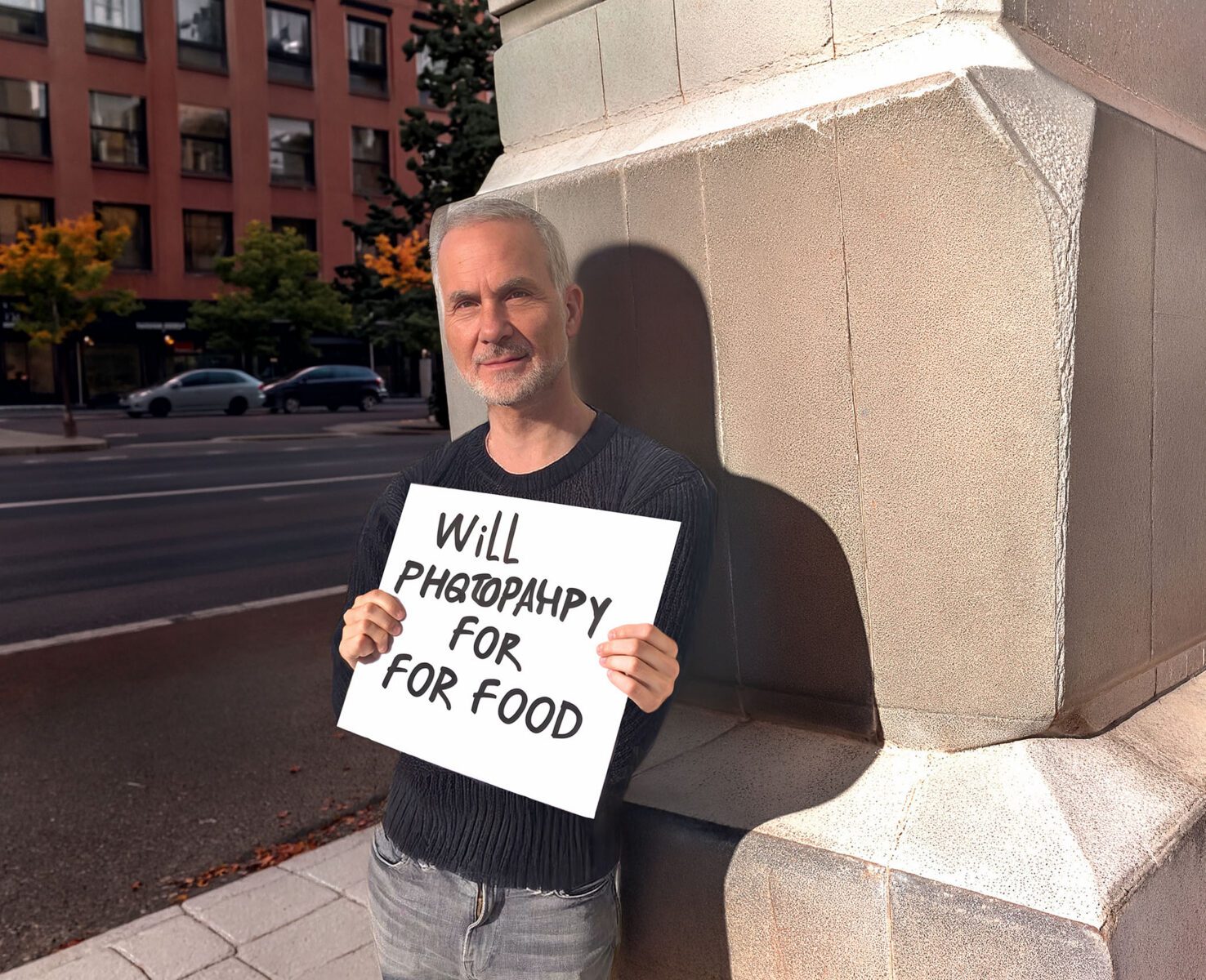
Here’s my first AI generated pic. Looks like AI isn’t quite ready for prime time.
I used a real headshot of myself and then generated the sign and street scene from AI. The sign was prompted to say “Will Photograph for Food” 🙂